Learning and Development: The Key To Shape Agile Workforce

“The only thing worse than training your employees and having them leave is not training them and having them stay.” — Henry Ford, Founder, Ford Motor Company

The present market climate is fast-paced, challenging and constantly evolving. Global leaders in the top echelons of management need the skills to meet ever-new conditions, so their development as leaders and as well as that of the organization cannot be left to chance. Employee training provides a good learning and growth approach, so their leadership skills are constantly sharpened. This constant upskilling is provided by the Learning and Development function of the HR department. By developing talent, honing skills and providing expertise, it aims to enhance group and individual performance. Research shows that having strong learning functions helps in employee retention too.

Why do we need to train?

Learning and development, also referred to as training and development, is part of the talent management policy of an organization and is intended to integrate group and individual goals and results with the overarching vision and goals of the organisation

Hence the HR function is responsible for:

  • The growth of talent
  • Recognising the gaps in skills between groups and teams often by SMART goals
  • Doing performance assessments and one-to-one interviews and 
  • Finding appropriate training to fill these gaps.

Evolution of talent development

Over the past decade, due to a variety of factors, the global workforce has been continuously changing. The mix of workforce is being reshaped by

  • Increasing competition in the market 
  • Growing uncertainty
  • Digital revolution 

In the meantime, continuing ambiguity, a multigenerational demographic, and a shorter shelf life for skills have put a premium on reskilling and upskilling. Naturally, technology is a driving force behind a lot of change, revolutionizing workplaces and learning. Over the past few years, it has itself undergone a constant revolution.

Earlier corporate learning happened face to face in front of the trainer in a classroom. Today, there are many ways in which learning can happen, and chances are, unless it’s virtual, it won’t be in a classroom and it won’t be one trainer delivering a certain piece of content while everyone else is listening. Most definitely, it will be tech-enabled, i.e. either virtual or peer-to-peer learning. It could be a podcast, a TED talk, a YouTube video, and the alternatives in today’s world are infinite.

Organizations today are using new and evolved learning and development strategies and have basically divided the function into 5 key areas.

The 5 key areas of talent development

L&D executives aim to develop and shape a learning strategy based on the company’s business and talent strategies. The learning plan aims to encourage professional growth and develop skills around the enterprise, on time, and in a cost-effective manner. In addition, the learning approach tries to reinforce the culture of the organization and motivate employees to live the values of the company.

Learning Design

Recently, reskilling has become an integral part of any organization’s growth. Often, many positions remain empty for months or even years due to a lack of the right talent to fill them. This affects not only the organization’s productivity, but interferes with team dynamics as well. While the supply of applicants in the market is continuously increasing, there is a dearth of skilled talent and hence the organization cannot depend solely on recruitment and talent acquisition. The need of the hour is to constantly train, develop and upskill existing workforce. This helps in keeping them relevant with the recent trends and saves the company’s hassle of hiring new employees. Further, internal movements are faster and more efficient. It is in line with Maslow’s Theory, where personal growth of the employee leads to greater job satisfaction and better productivity. These needs are met by dedicated, personalized learning and development modules developed for the organization. 

Organizations effectively training their employees

Few organizations are performing quite well in the learning and development front.

  • Amazon’s ‘Career Choice’ 

A program that provides employees access to educational benefits after being a part of the company for as little as one year. The program also provides up to 95 percent tuition and fee coverage along with textbook reimbursement rates. While receiving a certification or associate degree, applicants may have access to up to $12,000, as long as they take classes in in-demand niches.

  • Pixar

Learning and Development offers a boost to creativity in organizations as well. Consider Pixar, which has a dedicated L&D wing called ‘Pixar University‘. It provides training and other learning programs for various disciplines to its employees. As a result, employees feel empowered to make better decisions. The company believes that learning is more effective as a team, and hence runs dedicated programs. As a result Pixar often produces marvelous pieces of work that gathered great success. Further, an ecosystem of learning encourages more and more employees to enroll for such learning programs, creating value for the organization.

Thus companies that prioritize Learning and Development have seen changes in terms of attraction of talent, employee engagement, market position, and more. Furthermore learning and development leaders believe that the skills required for today’s workforce have changed due to the rapidly shifting demands of the industry and would change even faster in the coming times. Companies would be focusing on individualized training which would enable their employees to create an ever-growing constellation of nano-degrees that would supplement their skills and interests. There would be a paradigm shift from Learn-to-Work to Work-to-Learn models and instead of providing training on need-to-know or an as-needed basis employees will be able to pull down training anywhere and anytime.

Written By
Shristi Shukla
Under the tutelage of The HR Club
IMI-New Delhi

HR Analytics: The New Language of Business

“Where do you see yourself in 5 years?” none of us would have mentioned working from home, social distancing, or waiting for the vaccine while answering this question. This shows us how unpredictable the world we live in is. How we eat, travel, socialize, work – it wouldn’t be wrong to generalize and say that everything around us is changing at a rapid speed and our ways of doing things as basic as breathing have been altered drastically. The same goes for organizations as well, who would have thought they would need to move the working bays or cubicles to the study or living rooms of their employees. However, in case of the organizations altering ways and processes wasn’t as easy as putting a mask on. Everything had to be thought through while strategizing the action plan and analytics played an important role in doing so.

Data Analytics has become quite popular and prevalent in the past decade. It is probably one of the most important tools the organizations use to have an edge over their competitors. Earlier, they used descriptive analysis to know about their businesses, customers, and products but now they derive predictive and prescriptive insights from the data they gather from different sources. So, there are different types of analytics, you ask? Let us discuss them briefly, before moving forward –

Descriptive Analytics gives information about “What happened?” – yearly Financial Report, Sales Report, or a Marketing Campaign report that gives you insights into how the organization has performed in the past year or quarter. It includes traditional business intelligence and visualizations like bar graphs, pie-charts, etc.

Diagnostic Analytics in the form of advanced analytics that provides us information about “Why is something happening?”. The insights are derived using techniques like data mining, drill-down, data discovery, etc.

Predictive Analytics provides information about “What is gonna happen?” or “What is likely to happen?” by analyzing the past data. This form of advanced analytics is characterized by insights that include regression analysis, forecasting, pattern matching, etc.

Prescriptive Analytics is a form of advanced analytics that provides information about “What should be done to achieve something?”. It is characterized by techniques like graph analysis, simulation, neural networks, machine learning, etc.

It is somewhat similar to the treatment given to the patient after proper analysis of the reports and after considering the current situation of the patient. Data analytics is not new to the industry, organizations have used it from time to time as per their requirements. However, the accelerating pace of the changes in the business environment has revolutionized the way data is being sourced and used to derive insights.

From your movie suggestions on Netflix to the ads you see on Instagram right after you search for it on any of the e-commerce websites, organizations use the data to provide a better customer experience by analyzing the consumer behavior and patterns. Likewise, the organizations conduct market research to analyze the market trend and consumer preferences before launching a new product or forecasting the sales targets among other things.

But, how does it benefit HR?

While many of us still believe that HR comes into the picture only on few occasions like for the final round of the interview process to discuss the compensation, in the yearly performance appraisal discussions, or during the exit processes. All this would have been true if we were to talk about the 90s but certainly is not relevant in the times we live in today. In the past decade, HR has made rapid progress in using the technology to add value to the business which has transformed the role of HR into a strategic partner who works alongside the top management to help them strategize the business more efficiently.

HR Analytics has emerged as a popular buzzword in the industry, in the last few years. HR teams now look for a more forward-looking report containing deeper insights that enable them to make well-informed and data-driven decisions which could not have been possible with the static reports alone. With the help of analytics, HR Managers derive meaningful insights using past employee data which is used to predict the future needs and preferences to make effective HR policies that are aligned with the business strategies.

In today’s world, where everything is dynamic the only constant thing that differentiates an organization from others is its Human Capital. Technology is changing every minute, which affects the demands of the customer as well. Therefore, having an agile workforce that adapts itself and learns new skills to keep up with the demands is imperative. To retain the top talent the organizations need to provide their employees with a great employee experience and  Organizations like Gallup, AON, Great Place To Work, etc. use analytics to help their clients formulate strategies that are people-centric and cost-effective.

Employee Engagement is one of the major concerns of organizations today. You ought to provide your employees with an experience that keeps them motivated and ensures that they remain productive during the entire employee life cycle. Analytics help the organizations pave their way through the uncertainty by helping them know the key focus areas on which the action plans need to be prepared and the best practices which play important role in the engagement levels of an employee. Analytics help in formulating data-driven workforce planning strategies where allocation, optimization, and addition (hiring), everything is guided by a pre-defined roadmap. Besides, it helps in identifying the skills and experience required by the organization to adapt to the forthcoming changes and then plan the training and career development plans accordingly.

In cases of mergers and acquisitions, analytics helps the organizations dig deeper into the culture of the new organizations which facilitates in the smooth transition of the existing people-practices.

Some Important Studies

Analytics help the organizations compare their performance not only to their historical performance but depending upon the needs of the organization they can compare their results with the global/ regional/ market/ industry norms as well – in other words where do they stand among their competitors.

Ever since the world went under lockdown, the studies carried out by the firms tried to emphasize on the impact Covid-19 has had on the businesses. The employee engagement surveys included the questions around the physical and mental well-being of the employees that helped the organizations address the issues which nobody would have anticipated earlier more effectively and responsibly. Here are some latest trend reports and researches that might interest you –

  • In the research conducted by AON, 87% of the participating organizations reported that they are considering to payout salary increases in 2021. The report is paid, however, you can see the highlights of the report here, AON’s Salary Increase Survey
  • In the third edition of the Global Employee eXperience Research, Kincentric focuses on how important it is to enhance the employee experience and the organizations must move fast to adapt and reassess the way they strategize. You can access the highlights of the research here, Kincentric’s Employee Experience Highlights
  • In 2021 Global Pandemic Survey Series, Mercer came up with a series of surveys where the participants shared their perspective towards different questions related to pandemic. The results could be seen on their live results page and can be drilled down basis the region, country, global market and US market.

Geoffrey Moore has correctly said. “Without Big Data, you are blind and deaf and in the middle of a freeway”. Analytics contributes to the productivity of the HR function and help the organizations move from words to actions using the knowledge and in-depth understanding of their human resources.

Written By
Shreya Agarwal
Under the tutelage of The HR Club
IMI-New Delhi

HR and FINANCE : An Important Collaboration

As John Muir said, “when we try to pick out anything by itself, we find it hitched to everything else in the universe.”

Most often its is perceived that HR and Finance belong to two different worlds. They even understand the different languages, one is more oriented towards people and its impact while the other depends on numbers and ROI.

The juxtaposition of the two functions is clearly visible but at the same time they have overlapping goals and are inter-dependent. Similarly, all the functions in an organization are intertwined and so are HR and Finance.

Relationship Between HR and Finance
Relationship between HR & Finance

The HR and Finance department have one ultimate goal to achieve a higher level of performance and profitability. More often than not, the managers perform inter-functional duties. For instance, HR managers have to consider the cost and benefits of hiring and firing. They must also consider the impact that the HR policies have on the profitability of the organization. These considerations require a good knowledge of data analysis and financial forecasting. Similarly, Finance managers must estimate the impact of salary increment, bonuses and other monetary factors on the motivation and health of the employees to add value to the organization.

Collaboration between HR and finance is critical in optimizing the decision making of both parties. Finance has all the information as to where employees are adding value and what processes are succeeding, while HR can help finance understand when training is necessary. Building the ties can be a case of merging the departments – as some companies have done – or it can be a more subtle approach whereby controllers or the CFO take time explaining the numbers to HR leaders and help them understand why an initiative or a new software is not cost effective. HR’s expertise in areas such as recruitment, training and development, communication, motivation, dispute resolution, termination, can be equally useful to finance in looking past the numbers, as well as helping the finance function develop. 

A balanced coordination between HR and Finance is much needed, for which the Delta Air Lines stands as the quintessential example.

Delta Air Lines’ Leadership 7.5 strategy moved the company from a commitment to a control HR strategy, focusing on reducing costs and not worrying much abou employee commitment. In a front-page Wall Street Journal article about the Leadership 7.5 strategy, Delta CEO Ron Allen was quoted as saying, “Employee morale is not what it used to be. So be it.” Why? Because the new strategy had resulted in record profits for Delta in 1994. The day after the article came out, Delta employees began wearing “So Be It” buttons indicating their lack of engagement. Delta dropped to the bottom of the industry in on-time performance. The airline also had the highest number of baggage handling and customer complaints. In fact, from 1992 to 1993, customer complaints skyrocketed by 253 percent. Then the following year, complaints rose an additional 188 percent. Revenues from 1993 to 1998 rose at a compounded annual growth rate of just over 3 percent, when the industry average was 13 percent. Delta had lost its core customer: the business traveler. Here was an HR strategy that resulted in short-term profitability but had destroyed the human element that had been Delta’s source of competitive advantage.

Delta asks to suspend flights at Melbourne airport amid coronavirus pandemic
Delta Airlines case shows how the HR policies can have an affect on Revenue growth of a company.

A collaborative study conducted by Oracle and MIT Technology Review has found that a partnership between finance and HR will allow organizations to grow sustainably in an increasingly digital and cloud-based automated marketplace.

IMPACT OF THE INTEGRATION:

It is of utmost importance to understand this interdependency and be agile about the integration of the two functions. The people of an organization drive the business results and productivity of the organization. HR is responsible for supporting the said people which further helps to create a differentiating factor from the competitors and in turn have an edge over them. Thus, a healthy and happy workforce benefits an organization financially as well, as it lowers the turnover and increases productivity.

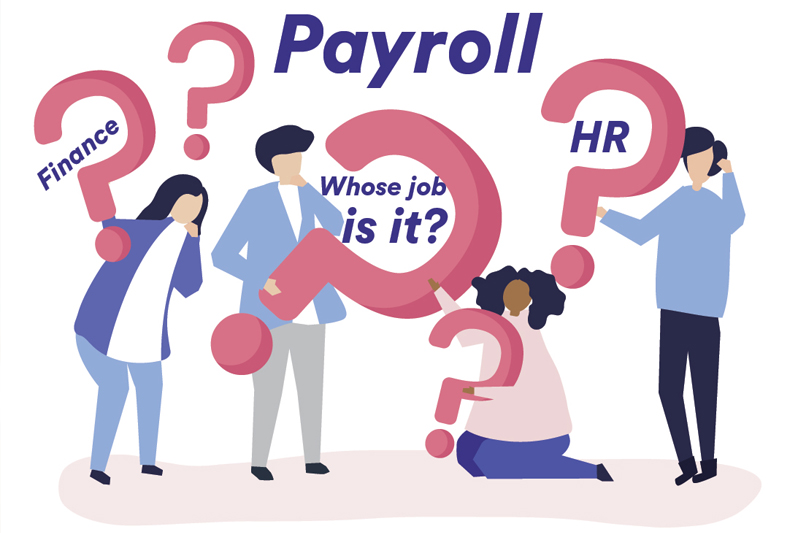
Payroll – Finance or HR – Whose job is it?

Going back to the basics, Organizational changes, recruitment, promotions, redesigning organization’s technology, and many more, everything requires streamlined processing. Without a viable integration, these processes are prone to human errors which can reduced by intervening the expert’s opinion.

According to a 2017 Global Survey, 35% of the companies plan to create a shared Finance and HR integration. Survey respondents believed that a closer Finance and HR collaboration is strategically necessary for productivity and performance, promoting excellence and increasing innovation.

According to a recent study by SHRM, approximately 50% of the HR professionals said that obtaining human capital was their most important financial challenge.

84% of businesses have disparate solutions that do not integrate. The integration of HR and Finance is on a study increase. By utilizing the functions of integration, HR & Finance will be able to gain valuable insights from each other. Disregard of open communication between HR & Finance and the lack of information being shared, a business is bound to struggle to compete in today’s market.

HOW TO ACHIEVE THIS COLLABORATION?

We can clearly see the importance of the integration of Finance and HR, but how should an organization proceed towards it?

  • Understanding organization’s purpose is the key.

When there is a solid understanding of the connections to the firm’s overall strategic vision, comprehension of each other’s purpose and critical evaluation of their shared value in supporting that vision, an HR & Finance collaboration truly be effective.

For HR professionals, it is important to understand the financial aspects of running  business and for finance, it would be important to understand workforce planning. Learning and applying these concepts is critical in order to foster a healthy HR & Finance collaboration.

  • Use of technology

Both functions can implement the usage of technology and analysis to quantify the HR functions and thus make the HR functions more understandable for the finance. Metrics such as Human capital ROI, employee engagement and satisfaction scores, compensation etc, can help HR justify its budgeting.

Some of the ERP maintaining companies have started working on the collaboration. For example, Financial Force offers Human Capital management & Financial Management on one single platform, Salesforce, to make the real time data available to both the functions and make a comprehensive decision accordingly.

Tim McAdam - General Partner @ TCV - Crunchbase Person Profile
FinancialForce

Among the benefits of integrating enterprise resource planning (ERP) and human capital management (HCM) systems is easier tracking and forecasting of employee costs for budgeting purposes.” Almost 90% ( according to study by Oracle and MIT) say cloud migration costs were either lower than or in line with expectations.

The importance of finance, HR collaboration with unified cloud
71% of the respondents believe that a single platform or cloud can bring HR & Finance together.

CONCLUSION:

HR and Finance, both will successfully play an important role in creating a healthy and balanced workforce and generating company’s output. HR needs to seek help from Finance in order to control benefit distribution and employees’ compensation planning. On the other hand, the company’s main goal profitability cannot be achieved without the participation of a superior workforce. So, both the functions cannot stay separated from each other in the fast-paced business environment.

As the saying goes, it takes two hands to clap; in the same tune, HR and Finance are required to run a business in a successful manner. Today’s HR department is becoming a sophisticated bottom-line business partner that requires more input and collaboration from the finance department than ever before. From sharing relevant employment data to maintaining joint responsibility for projects, HR and finance should be great pals, not warring adversaries.

As per Forrester, Human capital makes 70 % of the operational expenses and this percentage increases with the increasing economy.

Thus, a unified HR and Finance platform allows both perspectives into the data analysis and helps in making better long – term decisions.

Diksha Srivastava
Under the tutelage of
The HR Club, IMI New Delhi

Markruiting

Marketing and HR, the face of any firm, is perceived to be very distinguished aspects of the organization. The ever so important departments though are hardly ever thought of being associated with each other.

Even though the two verticals might not always be working together from the outset, the interrelation and interdependency are inevitable. They, together help in developing and maintaining the overall principles and the expectations, be it on the employee level or the customer perception level.

By introducing the term Markruiting (Marketing + Recruiting), there is an attempt to recognize and establish a direct connection between the two, and project identify relevant opportunities.

Interestingly, over time, there has been an introduction of certain processes that not only help in establishing a direct connection between the two but also helps in achieving enhanced and optimized results. One such process that has picked up in the last decade or so is recruitment marketing.

What do we achieve through this?

The main purpose of this process is to not only position the organization as a “preferred employer” to all the prospective employees, but also to target the candidate that is best suited per the organization policies, principles, and the expected role. Especially in the current times of the pandemic where there is an increased focus on mitigating the damage caused to the employer due to pay cuts and layoffs, there is an increased need to focus on hiring and marketing right.

Let’s look at some of the trends and techniques firms can and are adopting in order to dominate the recruitment marketing space:

Employer Branding

With the uncertainty of every nature at its peak, especially with the slow down in the job markets, the concern among the job candidates about who their employer is, what their narrative and mission is, and how they might fit into the organization, has become a major decision point. The employer branding concept tries to address this concern with respect to the organization, by trying and communicating to the prospective candidates about their beliefs and employee-centric policies to lure them.

Employer-candidate connect

Here, there is a need to develop a consistent brand voice. Marketing techniques play a pivotal role here. It must be made sure that whatever channel of communication is chosen, internal of the company or external, the messaging must be consistent. There is no need to alter the message depending on the target audience.  

Some of the techniques that can be used are

  • Employee’s Testimonials
  • Showcasing office and workplace environment
  • Highlighting perks and benefits
  • Company events and awards

What better example to have, when we have Google itself running innovative employer branding techniques every now and then, thereby building a strong value proposition. With over 3 million applicants every year, the quantifiable and non-quantifiable benefits have been exemplary. They even went to the extent of collaborating with Hollywood and producing a film that glorified their employee culture and broke several myths that had been going around. (The Internship – starring Vince Vaughn and Owen Wilson)

Automating and Standardizing application channels

Building a common and easy to use dashboard for all the prospective candidate is necessary. You may have breakthrough marketing channels and campaigns for your employee branding and might even do you a world of good in terms of spreading the positive word about your brand. However, all these efforts might end up in vain, if the organization has multiple and unregulated channels for application, which might add several levels to the process and make the entire process non-optimal and tedious.

Example platform- Run powered by ADP

Automating the various channels of communication, without losing the personal touch, shall be crucial for recruiters in the upcoming times. This can be in terms of

  • Automated email replies
  • Robust email marketing,
  • Chatbots for new prospects,
  • Automated schedulers.

This will make sure that the engagement and the communication between the job seeker and the employer will be quicker, easier, and efficient and might even lead to a reduction in time to hire.

One of the best automated recruitment tools that are being used by various companies are

RUN (powered by ADP) – allows users to seek assistance from ADP’s recruitment experts for every type of candidate: contractors, part-time, or full-time. The tool also helps recruiters gather market insights and analyze compensation data in real-time to make competitive offers.

Shareability of Candidate experience

Encouraging current or even prospective candidates to engage on common employee reviewing platforms like Glassdoor, Indeed, etc. should be a much more widely adopted practice. Through this way, employees and candidates can anonymously share their experience after verifying their details and share their reviews about the process or the firm in general. This will help establish a feedback mechanism process, where the trends of the reviews can be analyzed to identify the good and the pain points of the employees and the candidates, and the respective corrective measures can be taken.

Employee Feedback platforms

Did you know that over 60% of job seekers have had a negative candidate experience, while 72% of them decided to voice their dissatisfaction publicly? The candidate experience you provide is the indicator of your corporate culture. As such, it represents a notable decision-making factor. Namely, 83% of candidates emphasize that negative experiences can hurt their perceptions of an employer.

For you as an employer, greater candidate churn means lots of bad publicity, as well as greater financial losses. Let’s take an example of Virgin Media that was losing over $5.4 million annually due to poor candidate experiences.

Effective openings emails

Even though this method might sound elementary, many firms have not been able to leverage the potential of this channel of communication effectively. An effective structure and formatting can increase the readability and the chances of conversion manifolds. Effective email marketing strategies can be applied in emails offering a new position.

Effectice Email Writing

For instance, creating a benefit-driven ad that is fun to read and reflect your brand might catch more attention and interest the user. It is important to highlight and tell the employees and the prospective candidates “what’s in it for them”.

Different variety of media should also be used to keep them engaged and intrigued. Incorporating images and videos about employees sharing their experience has reportedly shown a 40 % increase in the conversion rate or even higher.

Social Media Push

One of the most obvious and currently one of the effective ways to market a brand. With the abundance of detailed and accurate data available nowadays on consumer behaviour at low cost, there is ample opportunity for the firms to identify their prospective candidates and understand their current job roles and need, and target them at lower costs.

Effective Social Media leading to near optimal recruiting

Marriott, a leading lodging enterprise, has an awesome Instagram page called Marriott Careers. They use it to publish the photos of their employees, share their insights, and emphasize why they appreciate them as a part of their team.

Recruitment marketing is slowly becoming a process which is inevitable as firms are realizing that –

“ If the reputation of a company’s products and services is its face, the talent brand is its heart and soul”
Hank Stringer & Rusty Rueff

Written By
Utsav Mittal
Under the tutelage of The HR Club
IMI-New Delhi

Performance Management in the New Normal

To improve is to change; to be perfect is to have changed often – Winston Churchill

The end of 2020 marks the beginning of the performance evaluation and appraisal season. Back in the “old” normal, employees would start self-evaluating their performances and peer-evaluation by this time of the year, but this year it is a different story altogether – uncertain and challenging.

Covid-19 has changed the working environment and culture of the organizations. Remote working has disrupted the entire business landscape and HR departments have been trying to run “Business As Usual” ever since the world went under lockdown. Reassuring employees by providing them required support and revisiting their existing strategies to boost Employee Satisfaction has been of the utmost importance for the HRs, and organizations have done a commendable job in doing so.

Performance Management plays a key role in ensuring the employees are engaged and perform to the best of their abilities and deliver high-quality work to achieve their individual goals which further contribute to the success of the organizations. On one hand, everyone awaits the distribution of the Covid-19 vaccine and on the other, the global economy battles the ill effects of pandemic accompanied by the recession. Annual Performance Review just around the corner has made things even more complicated for the businesses and has posed a greater challenge on the HR Managers of figuring out a new and effective Performance Management, and Rewards and Recognition system.

Traditional Performance Management System

Performance Management is often confused with the Annual Performance Review. Performance Management System (PMS) is an ongoing process of helping the employee identify the key focus areas to increase performance and productivity. Whereas Annual Performance Review (APR), is the actual evaluation of the performance of the individual and is often linked to the Appraisals and Incentives, which is a part of the PMS. Another way to think of the difference between the two is that APR is about the performance of the past, meaning how the employee performed in the immediate past while PMS focuses on the present and future performance of the employee. Most organizations today follow a linear approach to Performance Management –

How relevant is traditional PMS in these uncertain times?

The HR Managers have been trying to strike an effective balance between the uncertain environment and productivity of their employees ever since they started working from their “home-offices” which coincided with the start of this year’s performance cycle.

In March, Facebook announced that it would give all its 45K employees the same rating – Exceeding Expectations for the next two quarters. While some organizations have cancelled their Performance Review Cycle for this year some are trying to make changes to their existing PMS to make it more effective and meaningful. Employees were certainly not able to perform to the fullest of their capabilities this year. However, organizations cannot move forward without taking into account all that the world has been through in the past 10 months.

Now the questions that need the immediate redressal are – How will you make the goals and performance management more meaningful and relevant according to these uncertain times? Is it a good idea to pay bonuses and incentives based on the performance? While the employees were struggling to get their emotional and professional life together this year, adding money to the mix would not make a healthy cookie.  

In a survey conducted by Gartner involving the organizations where performance review is a usual practice, 73% of the participating organizations responded that they are planning to conduct the mid-year performance review this year. They recognize that the performance review discussion can be a good way to appreciate and acknowledge the contributions of the employees and provide them with feedback.

Of the remaining 27% organizations which are not conducting the formal reviews, 8% have delayed their reviews, 14% have made it optional while 5% have completely cancelled the reviews depending upon the extent of disruption brought in by the pandemic.

How to boost employee performance?

Gartner in its guide to driving productivity and engagement during the times of disruption has suggested the following ways to boost the performance of the employees –

  • Focus on Contribution

Measuring performance is going to be tough this year, given the changes and the uncertainty in the business and personal environment. Recognizing employees for their contribution is a cost-effective way of improving the performance of the employees. It is important to recognize the accomplishments – leadership and high performance, that has helped the organizations pave their way during the pandemic.

  • Redefine Goals and Priorities

As the strategies have changed to cope up with the global economy, the managers and the employees need to have a clear understanding of the business plan. They must know what business outcomes are in their sphere of influence and how will they deliver the same. It is also important to define the objectives of the performance accordingly and the indicators of high-performance. Instead of asking about the past performances they can discuss the short-term plans of the employees and extend their support in achieving the same.

  • Acknowledge New Realities

Managers should demonstrate empathy and trust, look out for changes in behaviour and attitude to check on the wellbeing and adjustment of the new work realities. The managers need to have a dialogue with the employees in how the organization plans on implementing certain strategies instead of telling the employees what to do, they must take into account the suggestions given by the employees as well.

  • Constant Reviews and Feedback

Having regular conversations around the performance and the key focus areas help the employees and the managers establish a rhythm of collaboration wherein both of them share the accountability for performance and growth. Managers need to identify and communicate the opportunity areas to help employees improve their performance. Working from home completely can both engage or disengage an employee, and the level of engagement depends on how well the manager has been able to handle the remote working situation. The following Gallup research shows how the frequency of connects has been a key to engaging the remote workforce.

The present situation requires immediate and long-term strategies focusing on employee performance. The initial changes made in the strategies did not necessarily include the performance management system, as the main focus then was to run Business As Usual. Now that the pieces are reorganized, it calls for the need to have the fundamentals of good management more than ever – Agile Goals, High Performance and Coaching. In the new normal, performance will be delivered by the ones who will be bold enough to change and adapt!

Written By
Shreya Agarwal
Under the tutelage of The HR Club
IMI-New Delhi

Is your workplace just diversified or inclusive too?

Are you Gay? Are you Brown? Are you a minority? Are you an introvert?

Some questions that set the stereotypical cloak, clouding the better judgements. We are currently living in an era where the world is progressing, albeit slowly but it is a start. People are more accepting, understanding and valuing the differences that exist in the environment. That is the very definition of Diversity.

PERCEPTION WITH A GENERATION GAP

Deloitte in a report revealed that diversity can be a product of generation gap. Different generations perceive diversity differently. On one hand, for Gen X and Boomers, workplace diversity is equality and fairness regardless of demographics, having no relation with an organization’s success or failure. On the other hand, Millennials, are of the view that workplace diversity is the combination of different backgrounds, experiences and perspectives taking advantage of which leads to innovation and differentiation from the competitors. 

Diversity and Inclusion go hand in hand. It behooves an organization to not just be a diversified workplace but also a respective and collaborative one. Companies that create diverse and inclusive work environments are more adaptable, creative, and become magnets that attract top talent.  “We often forget the ‘I’ in the D&I conversation,” says Johnny C. Taylor, Jr., SHRM-SCP, president, and chief executive officer of the Society for Human Resource Management (SHRM). “The challenge is in having a culture where all employees feel included. It is a major investment to bring talent into your organization, so why bring them in if they are not happy when they get here? You’ve got to get the inclusion part right.”

INCLUSION & COLLABORATION

A part of a Human Resource Manager duties, now a days, include managing diversity and inclusion of their organization. But, for a better effect across the firm, every employee must be inclusive and collaborative to make the workplace a great place to be. For this, educating the leaders is important. The Principle of Authority states that a person tends to comply with the people in positions of authority. Hence, with the leaders structuring meetings, allocating resources, and using language that advances inclusion, employees will see that inclusive behaviour is a core competence.

Also, a proper channel of communication needs to be maintained to look after diversity and inclusion being incorporated as a key value of the organisation. Johnson & Johnson has a Global Diversity and Inclusion Vision which says that “to maximise the global power of diversity and inclusion, to drive superior business results and sustainable competitive advantage.” For this, a Chief Diversity Officer has been appointed who reports directly to the CEO. In addition to that, various mentoring programmes and “Diversity University” (a website) helps employees understand the benefits of working collaboratively. Various rewards and recognitions the company has received include being recognised by U.S. Veterans Magazine as the “Best of the Best” for strides made in diversity efforts, and being one of only two companies that have been on the Working Mother 100 Best list for the past 28 years.

Celebrating the differences and listening without a pre-conceived notion goes a long way. Prayer rooms and various festivities can be incorporated and help create a safe place for the employees who feel the need to fit in with the majority. Taking Novartis as an example, within the organization the word ‘disability’ has been replaced with ‘diversability’ because they do not view people living with the disabilities as having the lack of ability, but rather having diverse skills and proficiencies. Human Resources professionals in the company are also educated on topics such as unconscious bias, inclusive leadership, disabilities/accommodations, and compensation/pay equity to improve their diversity hiring methods.

DIVERSITY & INCLUSION – A BARRIER?

Well! Despite its importance, many organizations struggle with designing and executing a successful D&I. According to the recent survey by PwC, 33% of the organizations see D&I as a barrier to their progression. This might be to due to the communication barriers and change resistant workforce. This can lead to workplace microaggressions which can turn into a hostile workplace damaging the brand image of the company. 

IMPORTANCE OF D&I

Arguably, when organizations invest in diversity, they gain, not only in apparent and economic ways but also in other subtle forms of stronger allegiance, greater well-being, and respect that they command in the process. Creating an inclusive culture must focus beyond diversity-based recruitment and diversity training and include holistic ways to leverage on diversity. It involves rephrasing the conversation from demographic diversity to thought diversity and finally to inclusion, and addressing biases, both conscious and unconscious that may hinder acceptance and integration. When employees feel included, in a true sense, beyond mere lip service, they are able to bring the whole of themselves to the organization, expressing and giving voice in an unhindered way that enables effective problem solving, creativity, innovation and enhanced performance in multiple ways.

“A diverse mix of voices leads to better discussions, decisions, and outcomes for everyone.” — Sundar Pichai

Written By
Diksha Srivastava
Under the tutelage of The HR Club
IMI-New Delhi

Attracting the Right Talent for your Organization

Most people are trying to work for their dream company, but only a few explore what their dream company is doing to find them.

It is a known fact that the star employees do the most and the best work in any organization. But nowadays, many companies are doing an awful job of finding and retaining such talent. Highly competitive job markets are the biggest challenge that recruiters face today. There is a constant ‘war for talent’ amongst competitors who struggle to not only attract relevant talent in their organizations but to have them stay as well. Even the companies with extremely creative recruitment campaigns fail to stand out from the crowd while racing and competing for the same end goal: hiring the best talent for their organization.

Leaders want the best and the brightest talent to join their teams. They are always on the lookout for people who are motivated, creative, skilled, eager, experienced, and more importantly, are a perfect fit for their company’s corporate culture. One would assume that since these leaders and companies are aware of how important and scarce talent is, they would know how to source it. But the trends of previous years say otherwise.

A Research conducted by “McKinsey Global Survey: War for Talent 2000” depicts that:

Consequences of hiring the wrong talent

With companies hiring the wrong talent, they end up with employees who are not the right fit for their corporate culture or is just not right for one’s business, either way, the cost of hiring them can be huge. These misfits form a chunk of the workforce who are not being engaged and thinking of switching to a new job. Firms need to start building up strategies that can be employed to attract and engage relevant, potential applicants. This approach often proves to be more cost-effective and successful than traditional recruitment methods.

The employer’s role in hiring the right talent

In order to hire the right set of candidates, organizations are taking the following measures.

  • Articulating the company’s values and goals allow potential candidates to get an idea of the general culture and ethos of the business before applying for the position.
  • Identifying the correct target audience and engaging with them through some specific channels also helps in attracting talent. Leveraging platforms such as Quora and Twitter to create a brand image of the company and builds rapport and even having a relevant company blog increases brand awareness and influence. Blogs and articles help increase the number of web searches that lead to the brand online.
  • Encouraging the current employees to spread these values by word of mouth and personal recommendations help spread the brand message and advocate a career at their company. The process of hiring candidates referred to the company by current employees or acquaintances is faster and more reliable than conventional methods of hiring candidates without any past information.

A glimpse of the Industry Insights

According to a study by JobVite, it normally takes 29 days to hire a candidate recommended by an employee, compared to 39 days from a work posting or 55 days through a career site. Thus, the company’s engaged employees who are the right fit for them set up a gravitational field for even more talented employees. They would be bringing in other thriving, vibrant workers, who will bring even more top talent through the doors. This effect has the potential to keep snowballing and eventually create a motivated, efficient, and effective workforce.

Employee Referrals improve the quality of hire

What is it that the modern workers are looking for in an employer?

In today’s time, with the whole world being online and candidates searching the company on social media, it is very important for the firms to have a positive brand image. They want to how is it to work at the company, what is its corporate culture, and what kind of employee experience do they offer. But at times they may not trust the company’s brand messaging. Instead, they believe in employees’ reviews and testimonials.

Hence the engaged employees of an organization are well placed to share information about open positions on social media. Their combined networks are far larger and help to reach out better talent. Numbers also show that when employees share brand-related content, their posts reach 561% further than corporate posts.

The compensation benefits that come along in a particular role are no longer the only component that candidates look out for these days. Purpose and fulfillment achieved from a role are also on the top agenda for many individuals. Companies by demonstrating why their brand does what it does also helps them attract applicants who are passionate and have the drive to achieve goals rather than simply getting a job to pay the bills.

People also seem less interested in working for a business where they no insight into what it’s like to work as part of their team. Trustworthiness, openness, and showing a fun and less formal view of life at the brand are key to depicting the company as an attractive proposition for talent.

LinkedIn’s Global Trends Report states that:

  • 66% of candidates care most about company culture
  • 54% of the perks offered and 
  • 50% consider the brand mission a priority.

How are Industry Leaders Hiring?

These trends are a direct testimony to the hiring processes at many leading organizations like GE, Starbucks, Google, Tesla and more. Let’s take the case of GE, where it was required to reposition itself as a digital company from an industrial one and hence needed to attract the right talent that could make this transition possible. GE released adverts which sent a clear message: the applicants applying to their organization should be motivated by valuable, cutting edge work and latest technology. If this isn’t what drove them, then GE might not be the right place for them. This was a clear example where company vision and mission played an increasingly essential role while evaluating job applicants, and thereby presenting a robust employer branding.

Another relevant example would be Starbucks. Embracing social media for recruiting new talent, both on the retail as well as corporate front, they engaged the job applicants via social media website and creative campaigns. The famous ‘#sbuxjobschat’ hashtag enabled aspiring job candidates to interact with their recruiters on platforms like Instagram, Twitter, etc.

In the end, the companies which remember that only talent attracts talent have a healthy employer brand. Thus, treating employees well and promoting the company should never be forgotten or neglected. Going the extra mile as an employer helps to illustrate the passion and a drive to provide the very best of service.

Written By
Shristi Shukla
Under the tutelage of The HR Club
IMI-New Delhi

Ideal Working Environment

We must’ve all come across Monday motivation jokes some time or the other. It’s safe to assume that many of us have found these relatable. Sometimes to an extent that we start believing that it’s a universal truth. What if we say that this can be changed? What if people start feeling enthusiastic about reporting to work every day? What if your work starts exciting you? What if you start looking forward to Mondays?

Wouldn’t it be nice?

If for a moment, all of the above queries turn true, we would call it an ideal working environment.

As easier as the term may seem from a subjective perspective, more complicated it gets when you start defining it from an objective view. So, before making premature assumptions about the same, let’s break it down and analyze the different components of a working environment in general.

A work environment constitutes physical, social, and psychological factors. The physical factors constitute location, facilities, ease of travel to the workplace, ergonomically designed physical environment, etc. The team culture, the peer to peer interaction, the employee to employer interactions, the bonding activities conducted as well as the collaborative nature of the employees defines the social nature of a firm. The kind of work, the work-life balance, the oppressive/friendly nature of the superior, one’s comfort level with the work can be considered as the determining psychological conditions of the employees within an organization.

Though all these factors are important, some of them are perceived and rated higher than others depending on the person’s personal preferences.

 A recent survey conducted by a consulting firm in the US nailed down the top five drivers of job satisfaction as reported by hourly workers.

The findings come about as a surprise, as it was observed that people have rated work-life balance higher than the increased compensation. This proves to be one of the major myth busters to all those aspiring young minds who are more incentivized by monetary benefits a firm provides than anything else.

It’s interesting to note that the fundamental concept of work-life balance, is subjective. It may not necessarily be about working within the stipulated forty-hour work week, but about aligning work with life, whatever it may look like at that time.

This gives us a fair idea about the importance of employee wellness in the workplace. So what are the factors that should be considered while laying down the components of employee wellness?

Working the Danish Way

Let’s take the example of one of the highest-ranked countries, Denmark, in terms of employee happiness and satisfaction and address the problem of employee wellness. Let’s see how their worker policies set them apart.

  • Reasonable Working hours

There is a general feeling among many employees that investing more working hours would prove to be a good depiction of one’s dedication and commitment towards work, and hence would lead to better feedback and maybe even incentives. Though this might work sometimes, it is also highly probable that this strategy backfires. The superiors start questioning their efficiencies and delegating powers and having put extra efforts into his work, the employee feels shattered and frustrated.

Some people wonder that Danes do not work. However, not only do Danes tend to leave work at a reasonable hour most days, but they also get five to six weeks of vacation per year, several national holidays, and up to a year of paid maternity/paternity leave. While the average American works 1,780 hours and the average South Korean 2,024 hours per year, the average Dane only works 1,408, according to Organization for Economic Cooperation and Development (OECD) statistics. Danes also have more leisure hours than any other OECD workers and the link between sufficient leisure and happiness is well established in the research.

  • Power Distance

The hierarchical model of a firm (Centralized / Decentralized) is an important factor while evaluating a working environment. This could be explained well using the term “Power Distance”. It is a score that is given to an organization, depicting the approachability of the superiors with their teams and their employees. Hence, the lower the score, the better the communication channel within the firm.

A lower power distance depicts more freedom, openness, and more approachability of the bosses with their employees. On a research conducted over 100 countries, Danish workplaces scored as low as 18 in comparison to countries like Belgium, China, and Malaysia scoring 65, 80, and 100 respectively.

  • Constant Training and Development

In this VUCA embedded environment, it is almost a compulsion for the employees to constantly upgrade and upskill themselves with the current technologies in the market to stay relevant.

Denmark, since the 1800s, has focussed on life-long education of its workers through an elaborate set of government, union, and corporate policies. This has allowed them to attend paid training programs and pick up relevant skills.

  • Focus on Happiness

Many people around the world hate their current jobs and react indifferently towards it. They feel it’s normal to feel this way. It goes to the extent where Scandinavians have arbejdsglæde, the Japanese have karoshi, as defined terms which means “Death from overwork.” This is something that is completely against the work culture of Denmark. Danish workplaces have a long-standing tradition of wanting to make their employees happy. To most of the employees there, a job isn’t just a way to get paid, but to enjoy at work.

A productive workforce is the engine behind a successful business or organization. However, it isn’t something that could be hired. It has to be created. It has to be earned. There is a need to make an employee feel appreciated and respected, regardless of their role, industry, or location. There is a need to have intent towards building an ideal working environment. Afterall no successful business could thrive or last, with a demotivated workforce.

“Engaging the hearts, minds, and hands of talent is the most sustainable source of competitive advantage.” – Greg Harris, President, and CEO of Quantum Workplace

Written By
Utsav Mittal
Under the tutelage of The HR Club
IMI-New Delhi
The Future of HR

Benjamin Franklin once said, “If you’re finished changing, you’re finished.”

The world is privy to changes and the industrial revolutions have been the enablers to drive those changes. The organisations have evolved in the personnel management from the past and survived vigorously in these unprecedented times of Covid pandemic, as you must have read in our blog series 2.1.1-HR Origins and 2.1.2-HR in Covid. But what does future holds for the HR function? How should organisations have a path forward towards their Human Capital Management? Well!! Most of these organisations already have a plan in motion while others are analysing and forecasting the trends to plan their next step. The world is about to go through the fourth Industrial Revolution, the term used to describe the convergence of AI, RPA, Machine Learning (ML), and cognitive platforms.

Industrial Revolutions Over the Years

The onset of the pandemic has been a wake-up call for the world. The dynamics of how we live and work has changed drastically. The rapid shifts have made it imperative for organisations to adapt to the pace of the world. The organisations are going back to the basics to rethink business models and strategies. The key factor to keep in mind, while making the decisions in these unprecedented times, is the expectations of the workforce. These decisions are crucial as they are going to impact the organisation and its human capital in the long run. Now, the HR Managers have to take on the driving seat and take the sustainable steps with agility for the future of human resources. 

KPMG’s “ Future of HR 2020 ” survey, in which over 1,300 HR executives from across the globe participated, 3 in 5 believe that the HR function will rapidly become irrelevant if it doesn’t modernise its approach to understanding and planning for the future needs of the workforce. 

The door to the future goes through three stages, each with equanimity and diligence. 

  1. Organisation future
  2. Workforce future, and
  3. The future of how work gets done

The future of the Organisation has to be reimagined today by sensing the community and shifting the organisation to a social enterprise and into a partnership ecosystem. Also, bringing in the culture of innovation and agility through workforce development is necessary. To increase the fluidity of workflow, digitization and automation have to be installed. A “fit-for-purpose” Operation model needs to be incorporated that is aligned with the organisation and enables the workplace collaboration. 

The external shift in the world leads to an internal shift in the organisation which in turn triggers the need to shift in mind-set, focus, traditions and enablers. The mind-set needs a shift by adaptation of new traits and behaviours to grow vigorously in the revolutionising age. The value of the organisation should be focused on human-centric solutions rather than customer-centric. No traditional ways set can help in tackling the challenges of today. So, the future of the workforce needs to be curated by the non-traditional talent and customising the workforce experience to increase team building and productivity. Continuous learning is required to be ready for the future, by forecasting future capabilities.

Future of HR- Deloitte

Shaping the workforce, to make them ready for the future is one of the key challenges faced by HR today. Workforce shaping is the understanding of how digital disruption and AI will change the overall shape, size, composition, and skills in the workforce and how humans and machines will work together to drive business value and a high-performing workforce. From the study by KPMG, 56% of the respondents agree that preparing the workforce for AI and related technologies will be the biggest challenge for their function. Almost, 76% of the respondents are prioritizing efforts around how to identify the future workforce. Some organizations, 66% of the respondents, agree that upskilling of workforce to deal with the impacts of automation and AI, is need of the hour.

“Culture is a living, breathing organism. HR should endeavor to position itself as a thought leader, a guardian of and enabler of culture.” —Jacqueline Welch, CHRO and CDO, Freddie Mac

Culture is nothing but a company’s personality. It is something that we can see evidently as soon as we set foot in the organisation. HR is the change agent who helps drive and establish the culture. With the unfolding of the recent events, change in culture is inevitable. Most of the organisations are trying to find the right culture, that can be long term and flexible enough to adapt any challenge that might come in the foreseeable future. Tech Mahindra, for example, recently announced that it is now giving the option of work from home or work from office to its employees. These changes are needed not only for the employees in the organisation but for the potential employees outside the organisation as well. Some of the organisations even have dedicated roles in HR to focus on the purpose and culture.

With the younger generation entering the workplace, their changing expectation and the advancement of technology, recruiting and retaining the employees have become even more challenging. The organisation needs to focus on enhancing employee experience in the three dimensions namely, digital experience, social experience and environmental experience. The new workforce expects a consumer grade experience at work. They want meaningful, rewarding work, on-demand customer service, simplified transactions, and instant access to information. Talent attraction is easier these days than talent retention. Organisations now understand that in order to create a positive customer experience, they first have to create a positive employee experience. Hence, a strategic design change is required in the organisation. Almost 50% of the HR managers agree that design thinking is the skill that is required in the HR function to add value to the organisation.

With the starting of the fourth Industrial Revolution, the shift towards digitization is inescapable. Organizations have started using AI Technology in works where human errors are easily avoidable. This is the time to understand the business in a more scientifically sophisticated way that enables HR to operate as a member of the leadership team and study the market trends using the data to add value to the organisation’s strategic planning. HR functions are using data from different sources to address business challenges relating to the workforce, including forestalling unwanted attrition, boosting productivity, understanding trends and emerging issues in workforce sentiment, etc. HR organisations are planning on investing in technologies like HR analytics and HR automation (Robotic Process Automation or RPA). But the technology can only provide with the trends and analytics from the data, the planning of people’s skills and driving the overall organisation’s agenda still requires humans. Thus, digital dexterity is the upcoming need for the HR functions. The experts have predicted that in the next two to three years, experimentation with the new technologies like AI will increase for the HR to find the best one suited for their organisation.

In 2020, we can see a new direction for HR that requires some new thinking about what HR does and what areas its work extends to, at a rudimentary level. This may begin with the customized workforce shaping to align with the organisation’s purpose or driving a more digital experience. An enhanced building of HR capabilities is required to carry forward these steps successfully. It lies in an organization’s ability to integrate new capabilities, taking an employee-centric focus while incorporating cultural shifts and embracing an increasingly digital workforce. Every HR organisation can take different routes with each one having its challenges. Success will require fresh thinking, adaptability and a thirst for adventure, because, in the future of HR, traditional transformation approaches no longer apply.

During the first industrial revolution, when the concept of workforce and employees came into picture, so did the role of Personnel management. Earlier it was focused more on controlling the employees to get more productivity, which was called the scientific management. Later in the 20th century the importance of employee satisfaction caught attention and several amendments were made to keep that intact. The department, the existence of which was questioned, was and is actually the one making the organisations more productive and holistic. The pandemic times have yet again proven the importance of the HR department, when the link between the organisation and its employees and thus its existence, was in question. The organisations, understanding the role of the HR function, are now ready to invest in its future and make it one of the most prominent functions of an organisation.

“We are humans. Organizations are run by humans. Humans can make it flourish or sink it deep. So, in essence, Humans are resource. Resources need to be managed meticulously. Thus, the HR Function will continue to evolve till the humans, as a resource, are extinct.”

References:
1. KPMG – “Future of HR 2020”
2. Deloitte – Reimagining Human Resources, The future of enterprise demands a new future of HR

Written By
Diksha Srivastava
Under the tutelage of The HR Club
IMI-New Delhi

HR in the times of Covid-19

“Human Resources isn’t a thing we do. It’s the thing that runs our business” Steve Wynn

Covid-19 pandemic has had a disruptive effect on our lives and economy. 2020 has been a challenging year, to say the least, and the pandemic has undoubtedly impacted the employee experience and brought a paradigm shift in the HR Strategy. For any organization, employee engagement is critical in driving its performance and HR Managers have adopted innovative measures to ensure their employees remain satisfied and motivated in their Home Offices, as the employers now like to call it.

The sudden changes in the work culture have brought many new unforeseen challenges for the HR Managers. In every organization, the HR department has been in the frontline, leading the efforts of addressing the issues of the employees.

  • Mental Health and Wellbeing

While it sounds good to say that “We are all in this together”, but the truth is every one of us is fighting battles in our heads entirely different from each other, therefore it would be wrong to generalize the mental state as a common experience. Nowhere to go and nobody to socialize with, negativity has strengthened its roots around everyone. Long working hours, pay cuts, job losses, job & internship offers cancellation has taken a toll on the mental health of the employees and all of this has only added to the negativity. HRs have stepped up to support their employees by prioritizing their mental and emotional wellbeing. Organizations across the globe are investing in wellness, employee assistance and stress management.

  • Employee Engagement

For any organization to achieve its business goals, it is important that the employees remain motivated and engaged so that they can deliver their best results. Today employers are giving more importance to employee experience and wellbeing, more than ever. As of the present situation, all an employee expects is the support and proper communication from its senior leadership. The employers are including questions related to the emotional wellbeing in their Employee Engagement studies to build more people-centric strategies. Employers are trying to cultivate a culture that makes their employees valued and appreciated.

  • Remote Working

Remote working has grown the demand for automation and other collaboration tools. To achieve future goals together the employees must stay connected with each other. The organizations where employees had the option to work from home even before the pandemic were better equipped to deal with the sudden outbreak without any major impact on productivity as business was as usual for them. As for the organizations where remote working was new the HRs had to strategize the transition in real-time. To provide employees with the right remote working tools,  gather real-time updates, address the queries and provide the required support to ensure the smooth working have been the key focus areas.

  • Communication

Communication is a critical aspect that needs to be taken into account whether the employees are working remotely or not. It becomes difficult to manage the workforce in absence of a clear and transparent channel of communication. Although Zoom/Webex and Slack/Trello are being widely used across the globe to meet the needs of the workforce, it still is difficult for the HRs to bring all their employees to the same page. To deal with this, HR Managers have come up with solutions like –

  • Assuring their employees that the measures taken by the organizations are compliant with the government policies
    • Updates for the leaders are being shared regularly preferably via video messages or webinars
    • Providing links to the valuable external information

The key management practices that contribute to an organization’s success is attracting and retaining the right talent. Over the years, the role of an HR has evolved from Hiring and Recruitment, and Appraisals to redefining New Working Models, Performance-centric Compensation, Organisational Restructuring, Managing Cost Optimization and Reduction Exercises without hampering the employer branding. They also play a decisive role in the long term sustenance of a business.

With the onset of the pandemic and the uncertainty of its exit, the way the employees remember this experience is now in the hands of the leadership and the HR strategists.   

(Stay tuned for the next edition (Volume 2.1.3) of the three-blog series on HR Evolution.)

Written By
Shreya Agarwal
Under the tutelage of The HR Club
IMI-New Delhi

Design a site like this with WordPress.com
Get started